
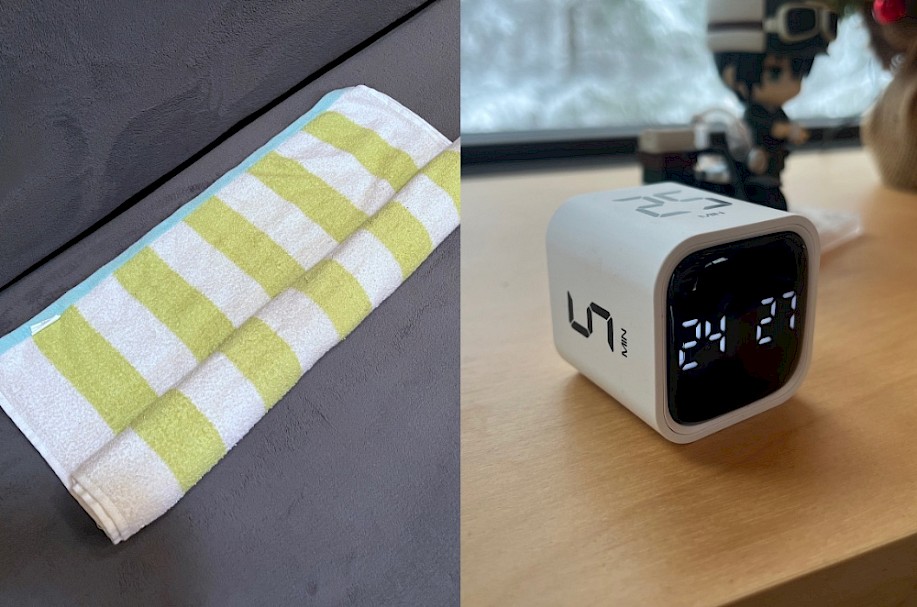
Disclosure: This article contains Amazon Associate links, which means I earn a small commission if you buy through them at no cost to you. Thanks for your support!
From time to time I’d like to share about some personal things that are, at best, tangentially related to living tiny. Lately, I’ve been blessed with the opportunity to spend a a bit more time than most of us get the chance to trying to get to the bottom of some of my day to day health issues (a.k.a. “figure out what’s wrong with me”), and my hope is to write the kind of article that I wished I’d had when I first started looking for answers.
What I’ve Learned From my Ongoing Battle with Chronic Neck Pain
I’ve suffered chronic neck pain since high school. I’ve always attributed it to a combination of poor posture (school desks are horrible), always carrying a heavy book bag on one shoulder, and genetics (my father had neck surgery in his 50s and lower back surgery in his 70s).
The pain that I get tends to be concentrated in the shoulders and upper back. Tension is often concentrated in the left trap and levator scapulae muscle (the opposite side from the shoulder I carried by book bag on), which I’ve come to learn makes sense anatomically but feels counter-intuitive.
I’ve had several x-rays but none have revealed anything out of the ordinary. I went to PT for a while. I finally started seeing chiropractors about 5 years ago. After the first session, I felt like I was able to stand up straight for the first time. Every time I leave the chiropractor now, I feel great. A day later? The tightness is back. The way that I’ve come to see it is this: chiropractic can loosen things up and sometimes get you out of a bind, but ultimately you need to learn how to avoid getting yourself into that bind to begin with.
Neck Tweaks
I worked a desk job in web development for 12 years. Despite attempts to optimize my workspace ergonomics, the problem progressively worsened over this period. I started experiencing mornings where I would get up, stretch, and inexplicably tweak something in my neck, putting me out of commission for days at a time, often when I was facing a tight deadline. At times, I couldn’t even lay on my back or find a comfortable position to sleep in. Any attempts to sooth the pain through stretching or massage just made it worse. Perhaps you know what I’m talking about. At the point of acute neck strain, nothing but ice, rest, and time will ultimately ease it.
At times I wondered if I would ever work at a computer again. This, in part, led to me leaving my full time web development job in Spring of 2024.
But even with more time away from the computer, the pain persisted. Back in August I suffered the worst “tweak” I’ve ever experienced. I woke up feeling fine, stretched the wrong way, and that was it. Recovery took over a month, with several relapses during that period. The process of research, discovery, and successful healing following this painful episode is what has led me to write this post in hopes that it will save someone else from similar suffering.
Everyone’s situation and body is different, so what’s been working for me might not work for you, but I want to share with you what has finally made the difference for me and has given me now over 3 months free from significant neck pain. The solutions were surprising, and weren’t always in line with the advice I had received from professionals or advice I found online.
Lesson #1: Sleep Position is Key
Sleep position was HUGE for me.
You’ve probably heard that sleeping on your stomach is bad for your neck, but for me even sleeping on my side or on my back with the wrong type of pillow can be straining to my neck. Basically, any non-neutral head position held for too long can precipitate a tweak. What revealed this for me was the slow process of recovery following my last episode. I kept on waking up feeling worse than the night before instead of better.
Why was I getting worse?
I had already made the discovery several years ago that using a pillow while sleeping on my back was generally counterproductive. For back sleepers, almost every pillow on the market is designed to lift the neck into a non-neutral, elevated position. For the past year or two I had been using a McKenzie neck roll without a pillow, which seemed to help reduce the recurrence of tweaks. In addition to supporting the curve of my neck, it helped keep my head from flopping side to side. But now after a night with the McKenzie roll, I was waking up with even more pain.
So I tried a night with no roll or pillow. I still woke up in pain. What was going on?
The $5 Solution: A Beach Towel Neck Roll
I finally decided to try something totally different. On a whim, I took a small beach towel, folded it in half, and then rolled it up most of the way, leaving a bit of the towel sticking out as a pillow to support my head slightly. In comparison to the Mckenzie roll, this felt like nothing. I could feel the rolled up portion of the towel on the back of my neck, but it didn’t feel like it was applying any pressure. It honestly felt unlikely to have any effect at all, but I was ready to try anything.
Incredibly—perhaps for the first time in a month—I woke up feeling relief.
I’ve been using the same beach towel rolled up in the same way ever since, and I’ve yet to have a tweak. Ironic that the least expensive and most conservative solution turned out to be the right one for me—no fancy, expensive pillows—just a $5 beach towel from Dollar General.
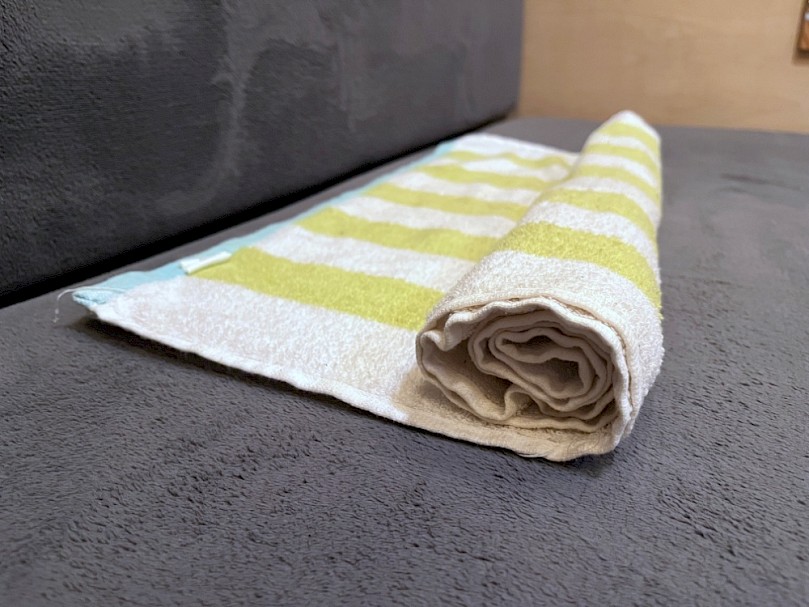
The problem is that I tend to start out the night on my back and then roll to my side, where a thicker pillow is necessary in order to keep my head in a neutral position. So I have a pillow next to me that is just right thickness for when I roll over onto my side. It’s not a perfect solution—I’d still like to figure out a way to reliably keep myself on my back with my head on the towel roll—but it’s working better than anything else I’ve tried.
When I do wake up in the morning in a non-neutral position, I’ll roll onto my back and spend a few minutes with the towel behind my neck before I get up for the day to give myself a quick “reset”.
Getting enough sleep is also important. Your body uses that time to heal.
Lesson #2: Regular Movement is More Important Than Maintaining Perfect Posture
I had tried everything: fixing my desk and monitor height, lumbar supports, neck strengthening exercises, different chairs, neck pillows, foam rollers, massagers, traction devices, heat pads, ice packs, stretches, weekly chiropractic, etc. Nothing provided lasting relief.
The fact is that the human body is designed for generalization—not specialization—but our jobs force us into specialization and repetition. Whether you have an active or a sedentary job, both are likely to put you into unnatural repetition for 8+ hours on end, and our culture of work generally doesn’t respect the need to intersperse regular periods of rest or movement throughout the day. In other words, whether you have a cushy white collar office job or a hands-on blue collar job, your job is probably destroying your body.
The Pomodoro Technique: Also Great for Back Pain
What works for me is this: Make time for movement every day, and don’t stay in one position for more than 25 minutes at a time without getting up and stretching. Ideally, take a 5 minute break.
Don’t get me wrong—ergonomics and posture are important. But even if I’m in the perfect ergonomic seated position with the top of my monitor at eye level and sitting up straight, I will still get neck and back pain if I stay seated for too long (even trying too hard to maintain perfect posture can cause strain!).
In fact, I’ve discovered that I can even work in my preferred working position (sitting cross-legged on my couch with my laptop) as long as I follow the 25 minute rule. This has been a real boon to my productivity.
This technique is greatly assisted by a pomodoro timer. If you struggle with task initiation and ADHD like I do, you can address both physical and mental health by integrating the pomodoro timer into your workflow. If you’re anything like me, having a dead simple timer like this is the only way to sustain this practice over time (and even then, it’s difficult!)
During my breaks I usually do the following two exercises:
- 2-3 Scapular retractions (I like to clasp my hands behind my back and do a bit of a neck retraction at the same time) — I often get a good little “pop” out of my upper back when I do this.
- 10-15 Wall angels — It might not always feel like this exercise is targeting the issue directly, but wall angels do great things for the upper back and neck.
Your mileage may vary, but I have been avoiding the more commonly recommended neck stretches as these have sometimes instigated tweaks/episodes for me. I have a very flexible neck (hypermobility) so I need to focus on stability and balance rather than flexibility.
Other movements that are helping me
- I have found careful and gentle use of the McKenzie neck extension exercise to be a lifesaver when I’ve felt an episode coming on.
- I also throw in a good doorway stretch before bed to counter the closed posture associated with working on the computer.
- I try to get in a 30 minute walk or hike outside each day.
Anxiety and Neck Tension
Finally, I feel like I should mention the role of anxiety in neck and upper back tension. Over time—as I have become more mindful of my emotional states—I’ve noticed a close correlation between neck tension and anxious feelings. Anxiety can put your body into a low-grade fight-or-flight state that causes muscles in the neck and back to contract. For me, talk therapy (both human and AI) and mindfulness meditation have helped me get to the root and release some of the tension that built up over so many years of my life of trying to push down strong emotions. But it’s a slow process.
A Note on Driving Position
I used to struggle a lot with neck and back pain while driving for long periods. Unfortunately, driving cross country doesn’t give you the luxury of breaking every 25 minutes to stretch and shift position. Here’s what I’ve found that works best.
- Recline your seat enough that you can “hang” your back on it. This removes the pressure from the lower back that can lead to lower back pain over time.
- Relax your head back into the headrest frequently to avoid the hunched position that can lead to upper back neck pain.
- To facilitate this posture, slide your seat as far forward as necessary.
- If you notice that you’ve settled back down into your seat, lift your butt off the seat a bit and push your back into the backrest to allow it to hold most of your weight again.
I’ve been able to drive thousands of miles using this technique.
If this article helped you out, please let me know in the comments below and feel free to share it with someone else who could benefit.
Product Recs
- Pomodoro Timer
- McKenzie Lumbar Roll - I find most lumbar rolls WAY too thick/extreme, but this one feels about right to me.
- Arnica Gel - Helps relieve muscle tension when you just need to loosen things up a bit.
- Microwavable Heating Pad - My favorite heating pad. Gives off a nice moist heat that lasts a long time. Much better than an electric pad.
- Peppermint Oil - Great for tension headaches.
- Tune Up Ball - Great low-tech back massage tool for small spaces


Categories: Simple Living
Comments: No comments yet
Post a comment